



Tasks set in utilities and agriculture sectors
Tasks set in utilities and agriculture sectors
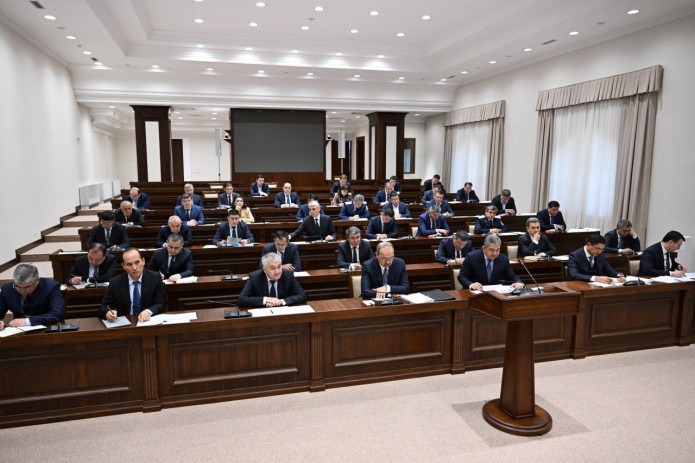
President Shavkat Mirziyoyev held a videoconference meeting on issues related to drinking water, heat supply, neighborhood development, and agriculture. The scale of these essential projects is expanding. This year, plans include laying 1,619 kilometers of drinking water and 521 kilometers of sewage networks, as well as constructing and reconstructing 162 facilities.
As a result, 715,000 people will receive clean drinking water for the first time, 135,000 households will be connected to the sewage network, and 157,000 consumers will have modern meters installed.
Following the President’s recent visit to France, three projects worth 340 million euros were agreed upon to improve drinking water systems in the Surkhandarya and Kashkadarya regions. The French company Suez will privatize drinking water supply in Denov, Shгrchi, Sariosiyo, and Kumkurgan, increasing centralized water coverage in the region to 90 percent.
A proper sewage system is crucial for construction, industry, and services. Although trillions of soums are allocated from the budget annually for its expansion, it was emphasized that the private sector should be more involved. For example, a local entrepreneur, with support from the Asian Development Bank, is building wastewater treatment plants in Almalyk, Bekabad, Angren, and Chirchik. Another entrepreneur has proposed privatizing water and sewage services in two districts of Andijan. The importance of increasing such private partnerships and encouraging large companies to participate in international tenders was highlighted.
A decision was made to simplify project implementation with international financial institutions. The tender process will be accelerated, and $850 million worth of work must be completed by the end of the year.
Another key task is the digitalization of the sector. The Asian Development Bank will provide $125 million for this purpose. Over the next five years, 4,800 smart meters and 2,800 telemetry systems will be installed at large water facilities and main pipelines. The electrical engineering industry will benefit from this, and instructions were given to increase the production of meters while gradually transferring their maintenance to the private sector.
Heat supply is one of the biggest consumers of natural gas. To improve energy efficiency, a presidential decree was issued on March 11 to reform this sector. The “Heat Supply” company was established, and 23 enterprises in the regions were placed under its structure. Over the next five years, 19 trillion soums will be invested in restoring heating systems, increasing centralized heating coverage from 37 percent to 58 percent.
The Ministry of Construction and Housing and Communal Services was tasked with improving energy efficiency in apartment buildings and public institutions. Nine thousand buildings will be switched to a closed heating system, reducing heat loss by half and cutting gas consumption by 20 percent.
The meeting also addressed spring planting efforts. Measures were introduced to simplify land allocation from khokimiyat reserves. The sale of rural land through auctions with installment payments will be canceled. For unsold land, the price will decrease by 10 percent per day in subsequent auctions. If only one participant joins a repeat auction, they will be declared the winner. Additionally, 10-20 percent of the land will be allocated for livestock fodder.
Currently, 93,000 farmers are being evaluated through an entrepreneurial rating system. This rating will now be categorized based on productivity, number of employees, and production volume. Farmers with a high rating will no longer need loan repayment insurance. Land tax will be reduced by three times, and contributions to the farmers' council will be cut by half. Those who exceed cotton and grain harvest quotas will be allowed to use up to 25 percent of their land for growing animal feed, vegetables, and other crops.
The President was briefed on agricultural and landscaping efforts in neighborhoods under the current month-long initiative. This spring, 125 million seedlings will be planted. To ensure effective irrigation, geomembrane-lined ponds will be built in water-scarce areas.
Last year, 208 neighborhoods piloted “neighborhood service” companies that provided 23 types of services. This year, the system will expand with 1,000 more such companies, increasing service types to at least 30. Inspired by China’s model, 5,000 people will be trained in neighborhood services, creating jobs for 15,000 people.
Additionally, 208 district and city maintenance departments have established internal road repair sections. A budget of 700 billion soums has been allocated for purchasing five types of special equipment. Authorities were instructed to repair internal roads and improve neighborhood energy supply.
The meeting concluded with reports from the Deputy Prime Ministers, ministers, and regional khokims.
.png "YouTube UZREPORT TV")